

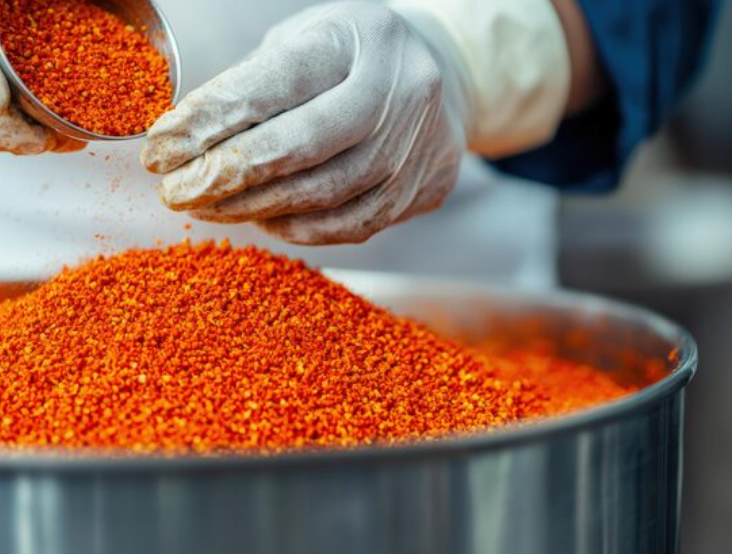
Though it has been used as a coloring for years, annatto still plays a role in today’s food production. It is derived from the seeds of Bixa orellana and can yield soft yellow, rich orange and deeper reddish-orange tints. This range makes annatto useful in dairy products, baked goods, snack coatings, seasonings, confectionery and prepared foods. Still, choosing annatto is not as simple as selecting a shade from a sample card. The final result depends on the pigment form, the recipe, the manufacturing process and storage conditions.
Understanding the Pigments Behind Annatto
Bixin and norbixin are the two pigments most closely associated with annatto. They behave differently, so one annatto preparation cannot automatically replace another. Some have better performance in products with more fat, and other forms work well in water systems. First, the product structure, target shade and processing conditions should be taken into consideration in the assessment of a team for annatto food color. This early review can reduce the risk of poor dispersion, uneven color and unexpected shade changes.
Why the Product Base Matters
The same color may behave differently in cheese, margarine, cake batter, dry seasoning or a beverage. Each product contains its own balance of fat, water, protein, starch, minerals and emulsifiers. These ingredients can alter the spread and the intensity of color. The color of the base is also important due to the color of the flour, cream, cocoa, fruit ingredients and spices, which can alter the final color.
Development trials should use the real formulation rather than a simplified test mixture. The normal order of ingredient addition should also be followed. A color that looks even in a laboratory sample may perform differently in a full production recipe.
Testing Under Real Processing Conditions
Annatto is often used in foods that are heated, baked, dried or stored for long periods. A quick bench test cannot show everything that may happen during manufacturing. In baked products, surface browning may darken the shade. Fat distribution and homogenization in dairy products can also affect texture.
The best trial is one that copies the actual process as closely as possible. Heat, mixing time, cooling and packaging should all be considered. The finished product should then be reviewed immediately after processing and again during shelf-life checks.
Getting Dosage and Mixing Right
Small dosage changes can produce noticeable differences, especially in pale foods. Rather than relying on one fixed rate, manufacturers should test a practical range and compare results side by side. The method of addition can be as important as the amount used. Some preparations benefit from pre-dispersion, while others can be added directly.
Mixing speed, shear, temperature and batch size should be recorded during development. These details become valuable when a formula moves from a small trial to larger equipment. Without clear records, a color that worked in the laboratory may be difficult to reproduce in production.
Checking Documentation Before Approval
Performance is only one part of commercial approval. Buyers and quality teams may also need product specifications, allergen statements, storage guidance, traceability records, certificates and local regulatory information. The actual form and strength of the Annatto Extract should be written in formulation and purchasing files.
Similar product names may represent different concentrations or delivery systems. Comparing suppliers only by price per kilogram can therefore be misleading. A preparation with stronger color value or better dispersion may require a lower dose and create fewer production problems. Reviewing total usage, handling and consistency gives procurement teams a more realistic basis for comparison.
Conclusion
Annatto remains a practical option for manufacturers seeking dependable yellow-to-orange shades, but successful use depends on more than choosing the pigment itself. The appearance of the finished product can be affected by product ingredients, solubility, dosage, mixing sequence, heat or storage. Avoid making unnecessary changes later by testing under actual production conditions, maintaining proper records and examining technical documents. The development, quality and ops and procurement teams collaborating makes scale-up more predictable. If you are a manufacturer interested in using an appropriate annatto system, you can visit Foodrgb.com to see the various solutions available according to the application and ask for specific technical assistance for your product.